
Executive Summary:
Roundworms remain a significant threat to cattle health, productivity and welfare, with increasing prevalence of anthelmintic resistance, changing climate and disease patterns and variable adoption of best practice across the UK. This report outlines the findings from a project entitled “Biosecurity and Roundworm Advice for Cattle Enterprises (BRACE)”, that was run in collaboration with EPIC, which had a remit to investigate the current prevalence of roundworms within the UK national herd and examine the role of cattle movements in the dissemination and transmission of roundworms and anthelmintic resistance.
The work showed two thirds of traded cattle were carrying roundworm infections and that almost half of the roundworms found in traded cattle were Ostertagia ostertagi, a species known to cause disease and economic loss. Faecal egg counts were generally low (<20 eggs per gram on average – a level which would not signal the need for treatment in monitoring samples). Despite the low parasite burden genetic analysis highlighted the presence of mutations associated with resistance to benzimidazole, one of only three anthelmintic classes available for controlling roundworms in cattle. Resistance-conferring mutations were identified in a small number of Ostertagia populations identified from samples from across the UK and the population structure suggested that resistance was at an early stage in this species. Some cattle also carried roundworms usually associated with sheep and with genetic traits indicative of more advanced resistance. These findings highlight the potential importance that an effective quarantine strategy can play in reducing the spread of resistant roundworms on British cattle farms
The overall aim of this project was to co-develop guidance with key cattle industry stakeholders to improve communication around roundworm control and biosecurity advice. The project provided practical evidence showing that incoming cattle frequently carry roundworms, including some carrying anthelmintic resistance-conferring mutations, and that some quarantine practices currently implemented on UK farms may not be suitable for preventing the introduction of these resistant roundworms into herds. The project findings have been evaluated by experts from the cattle industry and have informed the co-design of updated, industry endorsed, recommendations which highlight the need for greater diagnostic testing and improved communication with farmers.
• This study aimed to characterize the roundworm and anthelmintic resistance transmission risk posed by traded cattle in the UK throughout the year
• We examined roundworm communities recovered from traded cattle to assess species composition and the status of benzimidazole resistance in each species
• Mutations conferring benzimidazole resistance were identified in Ostertagia ostertagi and further examination of the population structures suggested that resistance to this anthelmintic class is still at an early stage in this species
• We have engaged with cattle vets and farmers to raise awareness of cattle gastrointestinal nematodes, the impact of uncontrolled infections on cattle productivity and the threat of anthelmintic resistance in these roundworm species
Roundworm risk in traded cattle:
This was the largest study of roundworms in British cattle to date, including 395 herds being sold through eight livestock auction markets across the UK during a total of 16 visits. A range of breeds and ages of store and breeding cattle, from both commercial and pedigree herds were sampled. Roundworms were prevalent in traded cattle, with 67% of animals tested at auction markets carrying roundworms. Egg counts were generally low, averaging 18 eggs per gram (epg), ranging from zero to 747 epg (Figure 1).
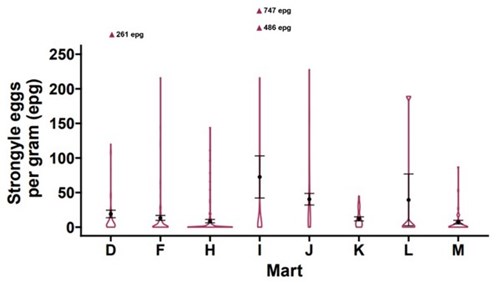
Figure 1. Faecal egg count distribution of roundworm eggs from faeces collected at different Great British marts.
Two key roundworm species were found to comprise the majority of the roundworm burden; the highly pathogenic species Ostertagia ostertagi, accounting for 42% of all roundworms identified and were present in 97% of positive samples; and Cooperia oncophora (Figure 2) which doesn’t typically cause clinical disease, but can exacerbate the pathogenicity of other nematode infections. C. oncophora represented 43% of all roundworms identified and was present in 88% of positive samples. Trichostrongylus axei and species more commonly associated with sheep hosts (e.g. Haemonchus contortus and Oesophagostomum venulosum) were also identified at a lower level.
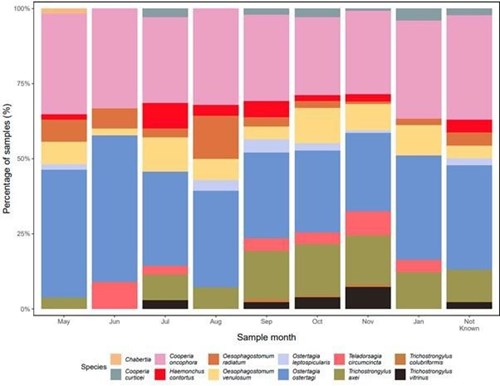
Figure 2. Roundworm species composition of roundworm eggs collected from cattle faeces from different GB markets at different times of the year.
Anthelmintic resistance:
Genetic mutations which have been associated with benzimidazole-resistance were found in 36% of all of the cattle populations tested, albeit in some cases at low frequencies which would not be expected to impact treatment efficacy at standard drug dosages. BZ-resistance associated mutations were identified in O. ostertagi, T. axei, H. contortus and Cooperia curticei populations.
Mutations were detected in a small number of the highly pathogenic O. ostertagi populations, with variable levels of prevalence. There were a small number of herds (3%), in which the mutation rates within the O. ostertagi populations from a farm sample were identified at a high frequency (>50%), levels which may cause clinical treatment failure on farm. Overall, the population structure of O. ostertagi suggested that resistance remains at an early stage in this species but could increase in the future. In C. oncophora, none of the mutations typically associated with white drench resistance were identified, but a novel mutation on the same gene was identified in samples from several herds. The function of the novel mutation remains unclear, but further investigation identified the same mutation in C. oncophora isolates from Canada and USA, suggesting that it could be functional. Further investigation would be required to ascertain whether this mutation also confers resistance to benzimidazoles. Some cattle were also carrying roundworms more generally associated with sheep with more advanced resistance.
Benzimidazole-resistance appears to be at an earlier stage and thus poses a considerably lower risk than that seen in other anthelmintic groups such as the macrocyclic lactones (ML, includes ivermectin and moxidectin), where resistance appears to be significantly further developed. With high prevalence of ML resistance more producers may switch to the use of BZs to control parasites which will apply a stronger selection pressure on the class leading to further resistance development.
• Changing patterns of species spread and resistance development with limited treatment options going forward means that we need to prioritise responsible use, monitoring efficacy and reducing unnecessary treatments
• There is a need to focus on messaging and knowledge exchange including behavioural change strategies and more accessible diagnostic support (e.g. FEC testing)
• Messaging needs to include resources and information on improving quarantine protocols, particularly around isolation and targeted wormer use in order slow down the farm-to-farm transmission of resistant worms
• There is a need for farm specific biosecurity policies including usable and adaptable annual vet reviews/health plans to help farmers manage risks associated with incoming stock and manure handling. Aligning national livestock health strategies with parasite-specific risks presents an important area for policy development
Despite the modest egg counts observed, the results emphasise the need for effective quarantine of incoming stock. One untreated cow with an egg count of 18 eggs per gram would pass out around 450,000 roundworm eggs each day, thus contributing significantly to pasture contamination. Adding the complexity of anthelmintic resistance, particularly in the pathogenic species O. ostertagi, action should be taken to minimise the risk of importing resistant roundworms on to farm.
Given the limited number of treatment options licensed for use in cattle, it is vital that the situation does not progress to the status currently observed in the sheep sector. Effective biosecurity is a key factor in reducing the rate of development and spread of anthelmintic resistance between farms. This study has illustrated that most cattle being sold at auction markets in Britain carry roundworms, and that a proportion of those roundworms are resistant to benzimidazole compounds. The current advice from the industry group Control Of Worms Sustainably (COWS) is to treat all incoming cattle with an effective anthelmintic, yard them for 48 hours and keep them separate from existing stock for 21 days. The findings from this study support that advice but the evidence of resistance to benzimidazoles, albeit at a relatively low level, highlights the importance of post-treatment faecal egg counting. There is no anthelmintic class for which resistance has not been identified (to some degree) in British cattle; therefore, testing is required to ensure treatment was effective. Post-treatment efficacy testing for a benzimidazole or macrocyclic lactone treatment should be conducted 10-14 days after and for levamisole treatment this should be 5-7 days after. If eggs are still observed, then animals should be re-treated with a different anthelmintic class, and post-treatment testing conducted again.
With cattle farming under scrutiny for their contributions to greenhouse gas emissions and the drive towards net zero targets, it is important that producers identify and mitigate inefficiencies within their systems. Promoting the findings of this study within the cattle sector would inform producers of the risk associated with incoming stock, emphasizing the importance of quarantine and post-treatment checks to avoid introducing anthelmintic resistant roundworms onto farm. Producers need to understand the impact that apparently sub-clinical roundworm infections have on cattle productivity and improve on farm biosecurity. If anthelmintic resistance in cattle roundworms advances significantly then infections will become difficult to control and cattle productivity will be hampered, adding significantly to the greenhouse gas emissions of the industry. This study has shown that resistance is at a relatively early stage at present, providing an opportunity for the cattle industry to act and slow the progression.
