Overview
All of the Scottish islands involved in the inter-island animal disease network (Lewis and Harris,
Orkney and Shetland) are unique, with distinct resources, topography and infrastructure that
means that livestock disease control is approached differently. Similarities between the islands
exist and there is potential, and enthusiasm, for inter-island collaborative working. Many
participants felt this was a unique opportunity to come together and share experiences and
key learnings that could only help all involved. There was a recognition that a ‘one size fits all’
solution would not be appropriate and that there was space to create shared actions. Together
they felt they could develop bespoke solutions to challenges many had already encountered.
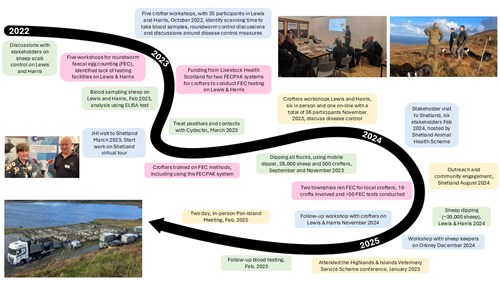
Building on previous work by the brief authors (Figure 1), the meeting was planned to deliver the following short- and longer-term objectives:
Facilitate Knowledge Sharing and Collaborative Solutions (Short term) – Encourage islanders to exchange experiences, information, and strategies to foster a working relationship that supports the co-develop of sustainable disease control strategies. It was recognised that while no single solution fits all contexts, lessons from the islands can benefit others.
Enhance animal disease control measures (long term) – To use the natural boundaries of islands to improve disease control while ensuring effective monitoring of incoming animals to prevent the introduction and spread of diseases.
Findings from previous individual workshops in combination with the interisland workshop have identified the following island-specific challenges and
opportunities:
Lewis & Harris have renewed their interest in intra-island community working and believe together they can achieve a good level of animal disease control. Challenges still exist, including;
• a lack of control over animals moving onto the islands (multiple ports of entry)
• limited vet service staffing, and services for diagnostics and treatment
• sourcing investment required for improved port infrastructure
Orkney has a well-supported livestock industry and want to move on to
addressing sheep scab on the islands. Their agriculture industry faces challenges including;
• a lack of monitoring and control of imported animals, particularly those arriving from the mainland
• the need for a new slaughterhouse on the islands
• a training requirement for dipping and dipping licences Shetland livestock producers have a robust process in place to control imported animals via the Shetland Animal Health Scheme. A bylaw put in place in July 2024 supports diagnostics and treatment of animals. They have fewer challenges but need to remain vigilant about potential disease incursions. They identified the following challenges;
• access to diagnostic tests can be challenging, mostly due to the remote nature of the islands and the need to send samples to centralised laboratories on the mainland for testing
• there can often be a long turnaround in obtaining diagnostic test results
• high lab costs for test results can be prohibitive for some producers
• lack of producer engagement with communal and collaborative activities
Together the island representatives identified potential areas of collaboration that will be put in place over the coming months. Future opportunities to meet, both online and face to face, will help further strengthen the collaboration and allow for the identification of new areas where connections can be made.
Strengthening regional animal health legislation – The success of Shetland’s bylaws on animal disease control have helped the island successfully manage a number of high priority animal diseases, a version of localised animal health policies may be developed and provide significant beneficial for other islands. Shetland has benefited from this level of disease control and are now able to brand their livestock as
coming from a high health status area and can thus ask for a premium price, due to the nature of the health checks that are in place on the island.
Improved livestock movement monitoring - Access to livestock movement data is essential to understanding the scale and nature of any disease risks and helps in the planning, development and implementation of effective control strategies. Making it easier for researchers to access the available data sources (e.g., animal movement, disease notifications and farm level data would enhance epidemiology
and disease tracking and help implement effective biosecurity measures. This could be achieved by having a broader overarching data sharing agreement with the EPIC CoE, rather than multiple individual data sharing requests. Cooperation from the ferry companies operating the transport links to, and between, the islands to collect and share animal movement data would be extremely useful (e.g., monitoring animal movements and disease spread). In addition, it was felt this assistance would enable them to make future plans and seek funding
to implement some of the required infrastructure and monitoring processes to be put into place. Seeking funding to improve port facilities, for example, lairage areas for animals when ferries are delayed would help to prevent animal health and welfare issues.